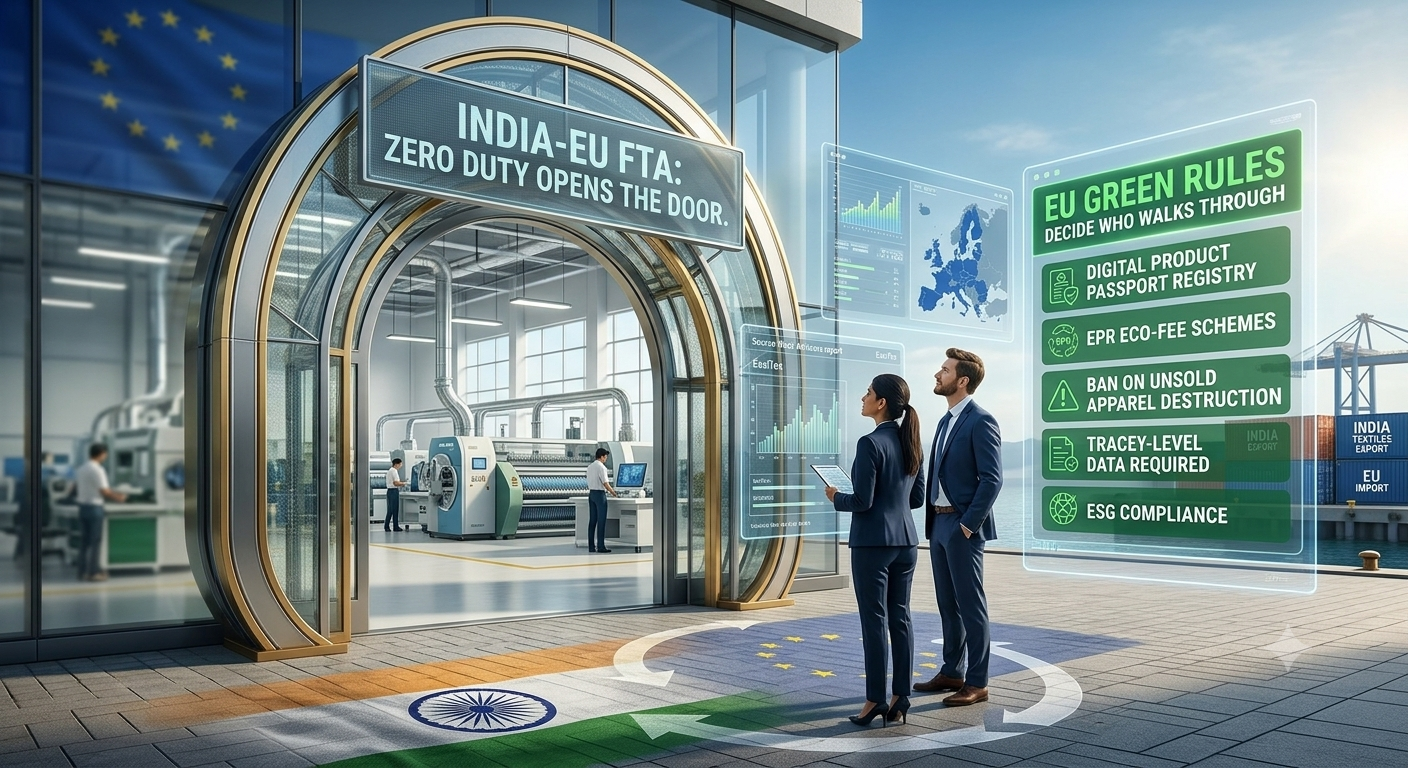
India's Commerce Secretary Rajesh Agrawal met European Commission trade officials in Brussels last week to discuss how the India-EU FTA will be implemented, with customs simplification and market access on the table. Negotiations concluded on 27 January, signing is proposed for mid-December and entry into force is targeted for 2027. Once in force, EU duties on Indian textiles and clothing, currently up to 12%, fall to zero across all tariff lines, according to the Ministry of Textiles.
Tariffs are only one gate. Since 19 July, large companies selling in the EU cannot destroy unsold apparel, accessories or footwear, barring ten defined exceptions. The EU's Digital Product Passport registry went live on 20 July, although the textile-specific rules are expected only in 2027. And member states must have textile EPR schemes running by 17 April 2028, with producer fees linked to environmental performance.
These rules bind EU brands and importers, not Indian factories directly. The likely effect is that their data and cost demands will travel down purchase orders. Exporters who can already supply garment-level data on materials, processes and origin, and who have agreed with buyers how unsold stock and returns are handled, may be better placed to turn the duty advantage into orders. The tariff cut brings buyers to the table. Readiness may help keep them there. Credits: Contributed by Neetika Agarwal Textile & Supply Chain Industry Enthusiast l Helping Founders & Experts Turn Insights into Scroll-Stopping and, the content used as it is. Easitex & Neetika Agarwal are launching a series of articles to build awareness and share practical insights on sustainability in the textile sector.
Conversation
Industry notes
No notes yet. Add the first perspective from the industry.